
June Please
Where else can my mind live but in words?

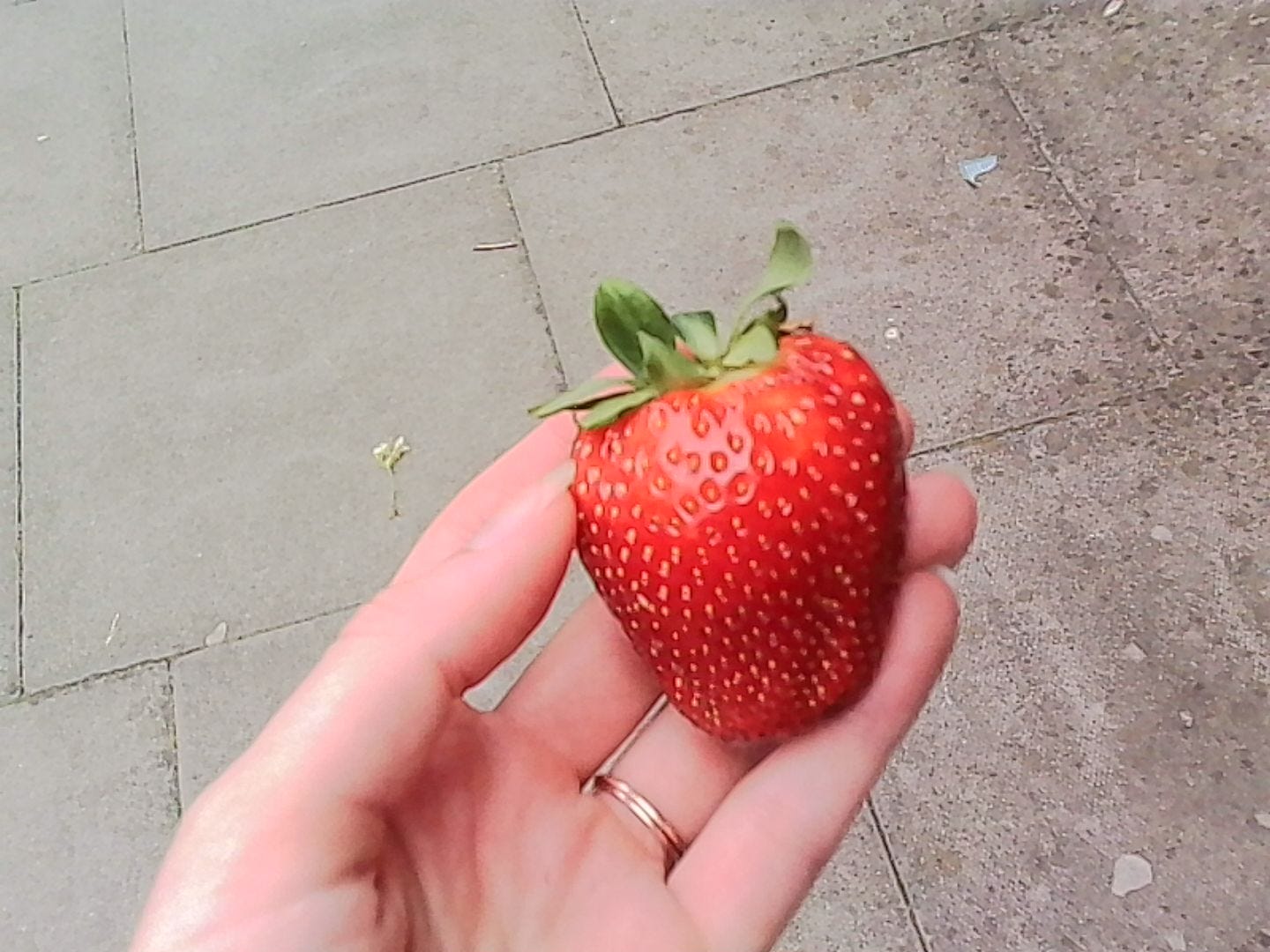
This was how I wanted to begin, with the little I know*
- Layli Long Solider, Ȟe Sápa, Four
Welcome back to Letter Please, the monthly newsletter for thinkers and over-thinkers everywhere. I write to you from London. My sister sent me this song last week, when I was ensconced inside my rented Victorian era flat, blinds closed against the sun, preparing to facilitate an online group and dripping in sweat. I didn’t think I could properly sweat. I am not a sweater. But this heatwave proved that all wrong.
Sun beats down on the concrete
It beats so hot, not even a palm tree
The house I live in doesn't have A.C.
It gets so hot, so I might as well daydream
It gets so hot that I can't even think straight
Letter Please
When AI first came on the scene I was casual in my rejection. I didn’t even look into it, I just knew it was a product/service I did not need or want, for myself or for the world; a solution that no one asked for, to a problem that did not exist. I love writing, even transactional or technical writing. I didn’t want to read something written by no one. I told my mum to use the “-AI” command at the end of her internet searches (sorry Mum, I can be bossy with you, can’t I — you are a hands-off parent and I am a hands-on daughter, jollying us along, making a plan, reminding you to stop picking the skin around your nails; authoritative daughtering?).
Other people I knew caught on to my refusal, too, and started giving sheepish caveats, “I know you don’t like it Hannah, but I used _______ to help me plan _____, it’s so good for this sort of thing!” This gave me pause. Not because I was anywhere near influenced, but because of the friction that my moralising had injected into the relationship. I didn’t think that they were bad, I just thought the whole thing was a giant waste (and a giant affront to things I hold dear).
After a while I stopped making my feelings known. I started to think of anti-AI use like a digital equivalent of something like vegetarianism. A strongly-held stance based on values around both justice and aesthetics, but ultimately a personal rather than truly structural action. Always worthwhile, for how can we live but by doing what we believe? A fine microscopic dent in the demand side of a cruel industry, or purifying for the soul, or motivating for the body. But more about integrity and congruence than evangelism.
It is not considered polite for vegetarians to knock the steak off the fork of their dining companion, is it. Aside from politeness, would that even be productive? Attraction is probably better than strenuous promotion or conversion. Live like you mean it, and the right people will find each other and build their amplitude together. Righteousness is pretty off-putting, and might do more for the pride of the protestor than anything useful. I started to feel the same about AI.
Or maybe it wasn’t exactly a mature utilitarian choice to stop talking, it’s just that AI was such an affront that I stopped even wanting to argue against it. If I didn’t talk about it it did not otherwise exist to me at all, and I could live the future I wanted, without AI. Or maybe I let myself start to feel sorrily marooned and useless. A critical mass seemed so all-in on it that my own stance started to seem more of a queer little choice than a feasible argument to reconsider the place of these companies’ LLM products.
One afternoon the school I was working at had a council-sponsored guest speaker come to talk to us about how to use AI to plan lessons and communicate with parents and guardians and summarise chunky education policy documents for us. There was no if whatsoever, only when and how. A few years earlier I would have given an impassioned case for the value of real human-human contact, and the value of reading and planning as thinking technologies, not pesky processes to outsource.
But the room was nodding along (or maybe nodding off, who knows, getting older means less automatic ascription of malice to behaviour). One new teacher gingerly raised her hand to ask about the ethics of AI use, what with the data centres and all the water and— but the speaker cut her off and told her not to feel bad, that the water-use argument was vastly overinflated, and, anyway, it’s already here, you don’t want to get left behind.
Was that what the anti-AI choice was — a wanting to be left behind? Was it an old contrarian freakhood stopping me from being an adopter? Was I just a deluded self-styled iconoclast? I remembered a Calvin and Hobbes comic strip where Calvin asks if you can “refuse to inherit the earth”. To which Hobbes responds,
“If you’re already born I think it’s too late”.
But no! I might have been able to bear my own discomfort alone lately, might have started to usefully question the place of pride and self-importance, but in that moment I let my wavelength be amplified by this person’s leadership. She was right to ask questions in an environment that was assuming — nay, policing! — inevitability.
Refusing AI was not refusing to inherit the earth. Not doing anything in a moment that mattered was refusing to inherit the earth, refusing to grapple with reality. But I don’t know if this account is completely right, either. Because it wasn’t as if I wasn’t living life like I meant it. I wasn’t totally enfeebled. In fact I wasn’t apathetic at all.
I was in survival mode but also thriving. I was barely coping but I was also unbelievably alive and well. I had little chance to eat or use the bathroom, but my body had never been more responsive to what I needed to do, flying high on a hyper-energy usually confined to my mind. No more desk-locked right shoulder, no more neck pain; I was on my feet all day, and fast on those feet at that. I was working in a teaching team where we understood each other’s every need with just a glance.
Everyone was devoted beyond measure to each child. And everyone was also devoted to the present moment, because we had to be. Everyone used their face as an animated canvas more engaging than any screen. Everyone looked out for the dignity of (and listened in ways beyond words to) the children that did not speak and who had not means to fully manage their own personal care. Life existed only in minutes and seconds.
Life existed only in a postmodern symphony of parallel echolalias and stims. Life existed in episodes of eye contact more clock-stopping than any meditation, and in a rotation of trusting pudgy hands in my reverent bony one. In this way I was short-sighted. In this way the after-school AI advocate was in such a different world to us that all we could do was nod, all the while internally safeguarding the truth of that life lived in minutes and seconds, in minute moments of service.
The speaker knew nothing of this world of intense physical and emotional and creative ministrations. Our labour was exploited and yet we were deeply, usefully, humanly employed. Yes, we had planning and reporting to do. But this spilled from and into our existence in those minutes and seconds. We asked each other what we thought would be best for the group and for each child, because we knew each of them, and we knew each other. We trusted a human intelligence almost completely unaccounted for in economic value. Care.
*
Digest Please
UN Report (A/HRC/62/CRP.2) June 18th 2026
“The essence of childhood has been destroyed”: Israel’s deliberate targeting of Palestinian children in the Occupied Palestinian Territory since 7 October 2023“Before my mother was killed, she told me, ‘I need you to be a good person in the society like doctor or engineer and do good for others.’ Despite everything that happened to my family, I will do anything that is good for the society.”
- A 13.5-year-old boy who was severely injured in the same airstrike on his house that killed his mother and two sisters in December 2023.Paragraph 354: Israel has targeted Palestinian children in Gaza in two distinct ways: directly by shooting at their vital organs using precision weapons such as quadcopters and snipers; and through use of high impact weapons causing widespread and systematic attacks on residential buildings, schools, and displacement camps crowded with children. Israel is also legally responsible for failing to protect Palestinian children from being targeted by Israeli soldiers and settlers in the West Bank, including East Jerusalem, and for allowing, enabling and encouraging ongoing settler violence, which serves to entrench settlements, annex Palestinian land and force Palestinians off their land.
Lena Dunham, Famesick
- Upvoting these top three life values: Art, Family, Making People Feel Seen
- Powerpoint mentioned!! (IYKYK)
- Had to put the book down for a moment when I read this part:
“The irony is that knowing I cannot have a child – my ability to accept that and move on – may be the only reason I deserve to be anyone’s parent at all. I think I finally have something to teach somebody.”Yiyun Li, Things in Nature Merely Grow
- A book written in/by the life lived after two suicides. After her first son Vincent died, Li wrote a novel befitting his poetic exuberance. But after the death of her second son James, a more exquisitely logical personality, Li must turn to nonfiction. The result is this memoir. Alongside her eldest son Li, too, is moved to live in language, “where else can my mind live but in words?” And alongside her youngest son she lives thanks to facts, “in this abyss that I call my life, facts, with their logic, meaning, and weight, are what I hold on to. It’s not much, this holding on, and yet it’s the best I can do.”
- Li helps us realise that there are people amongst us who live with unmet needs that may never be met meaningfully in this lifetime. At one point she says that, for her eldest son, “I don’t think life would have ever become easier.” However, she says, “I do believe that we come to suffer better … We also become less rigid: suffering suffuses one’s being; one no longer resists.”Ash Sarkar, “Is Screen Addiction Ruining Our Connection to Art?” If I Speak Podcast episode 117, Novara Media:
- “You can generate something more powerful than censorship, which is incuriosity, which you can generate through one hundred percent wraparound information overload. [Change is] not about who you vote for. It’s about taking on machines that make us into more enfeebled versions of the human species”.
Until next month may you be not enfeebled,
H x
subscribe / heart / leave a comment - it all helps
Archive Please
June 2025: “The unknown and the as-yet unmade — that’s what we’re meant to be working with, not spinning out received forms and gestures. What do poets do? They make forms. Poiesis leads into being what didn’t exist before … Courage, heart, community. Pig-headedness. Audacity. Ecstatic love. Or maybe routine: making is what we do, so we keep doing it no matter what, for better or worse. Agony might be for nothing, no meaning in suffering, but a form can make it feel alive and special — leading into being a new way for pain to matter.”
June 2024: “I don’t care if my time in Scotland is high-romance soul-retrieval one moment and bathos-squalor ambiguous-loss the next. I don’t care if I am inconsistent. I don’t care if the romance and the rage make jarring diagonals. It’s all real. I am in love with this place and we are living in a time of strain and horror and collapse. The ‘cost of living crisis’ has outgrown its twee monicker. Things aren’t going ‘back to normal’ after a wee blip or two. The owning class [think they] have got us in a chokehold…”
June 2023: “There are probably only two stories: the hero’s journey and the story of community. Maybe the biggest grief of my current early thirties life is that I am still lodged in the hero’s journey, against my will, seeking the safety to be a whole self. Unceasing shocks provide such little reprieve. I need a small gap of a clear shore to enable the story that comes after getting to know your self and your weaknesses and your light. There are so many hurdles and new things to process that get in the way of becoming an okay enough self so as to become a non-self in service of a collective. But there I go binarising things…”
June 2022: “Depression happens for me when there is rupture, exploitation, abuse or neglect. And when there is no clear recourse; when all avenues of agency feel exhausted; when the hectoring command to have an ‘internal locus of control’ becomes a contortionist and lonely act of tiny-fisted knocks against an immense and impenetrable door. Suffering happens, loss happens; that’s life, and that’s grief. Depression is harm plus no-way-out.”
June 2021: “Gone is the easy (hard!) commonality of life under strict lockdown, but yet to come is anything close to the easy-come-easy-go integrations of yore. Meeting up with someone is still an event, not yet spontaneous. Meeting up with someone is to receive a blood transfusion, hooking in to the alien knowledge of another body, a shock as much as a gift.”
June 2020: “I share a land-locked-in-London dream of swimming in a winking blue sea with all the swimming, bobbing bodies around me free from all conditions of domination. I remember hearing Gail Lewis talk in an interview about imagining a future where she can be unintelligible in terms of the normativity by which she is currently understood. Live that future, make it possible; don’t abandon the currently unknowable.”
*A quote can become a misquote when something crucial is omitted. In a way my epigraphic opener to this month’s newsletter is more of a blackout poem than a quote. I left out Layli Long Soldier’s next line. I had to, to let myself say anything at all on a difficult day. But here it is, rightfully restored:
… This
was how I wanted to begin, with the little
I know.
But could not.
Anti-use use as the "digital equivalent of something like vegetarianism" is such a canny observation Hannah. Where do we draw the line between personal choices and moral responsibilities? To what extent will these even be personal choices when class and socioeconomic status largely dictate access and ability to make certain choices? As AI begins to seep deeply into so many aspects of society - I guess becoming as widespread as meat eating, in what relationships will this start to create friction. How do we then navigate this friction? These feel like urgent and necessary questions which your thoughtful and inquisitive writing shines a light on. Still, your closing words leave us with hope - connection after all is the only thing that can save us from ourselves.
I feel like I should be grateful that atleast (for now) AI isn't putting my job at risk, but new AI detection systems in my work have inflated everyone's case load over the last year making the role harder, but our accountability and the expectations remain the same. Even for those of us whose jobs may not (for now) be at threat, employee lead conversations about how AI will impact our work life are lacking in many fields. A lot of the decisions are being made by people who are too far removed for it to personally affect them.
adored this <3